
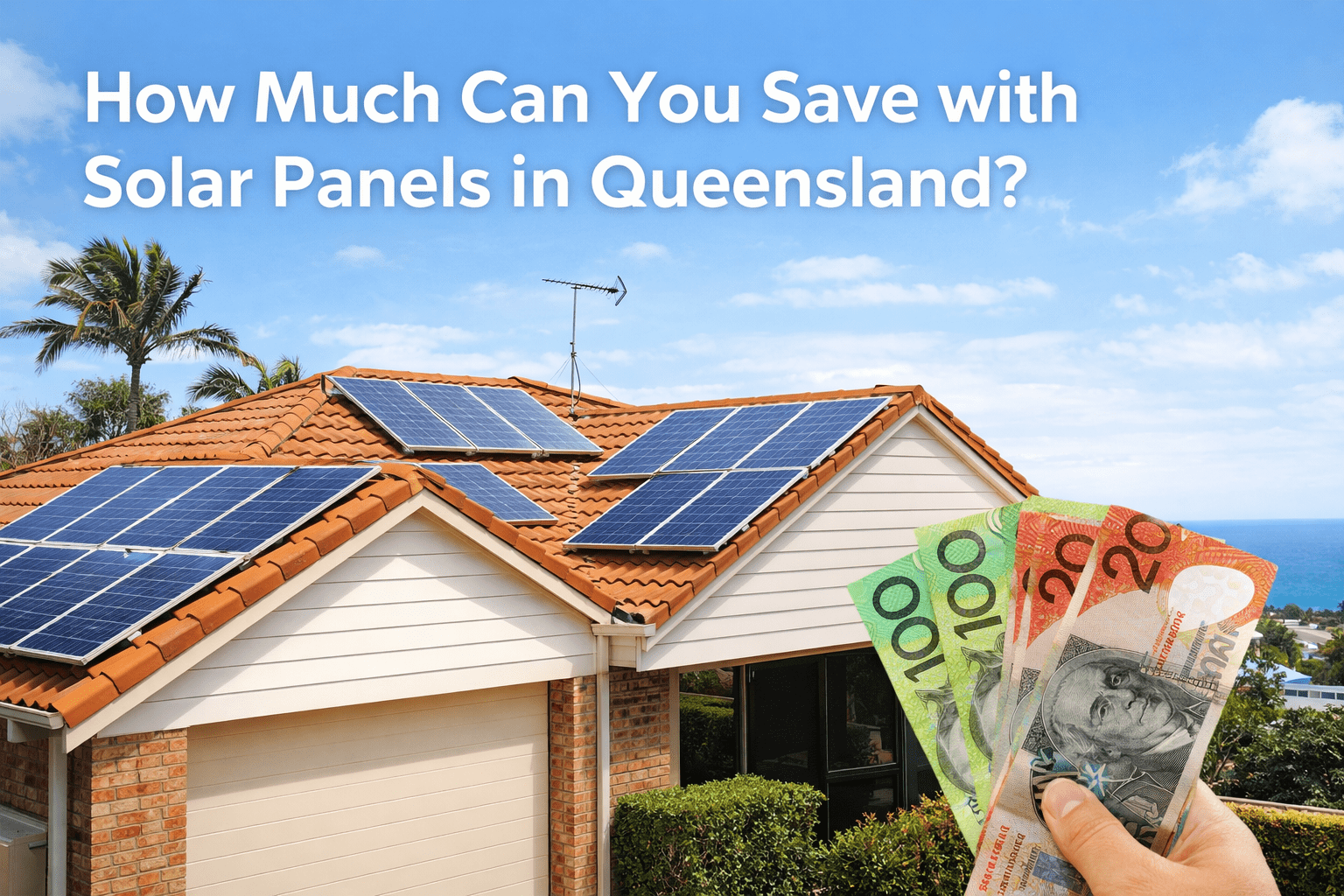
 With electricity prices continuing to climb across Queensland, more homeowners are asking the same question: is solar actually worth it, and how much money will it put back in my pocket?
The short answer is that most Queensland homeowners with a properly sized and installed solar system save between $1,200 and $3,000 or more per year on their electricity bills. But the exact number depends on several factors specific to your home, your usage patterns, and how your system is set up.
Here's a clear breakdown of everything that determines your savings, and what you can do to maximize them.
How Solar Panels Actually Reduce Your Electricity Bill
The principle behind solar savings is straightforward. Your panels generate electricity from sunlight during the day. Every unit of that electricity you use directly in your home is a unit you don't have to buy from the grid at retail prices, which in Queensland currently sit between 30 and 35 cents per kilowatt hour depending on your retailer and plan.
Any excess electricity your panels produce that you don't use immediately gets exported to the grid, and your energy retailer pays you a feed-in tariff for it. In Queensland, feed-in tariffs are typically between 5 and 12 cents per kilowatt hour, depending on your retailer.
This is the key insight most homeowners miss: using your own solar power directly is worth two to three times more than exporting it. Using a kilowatt hour yourself saves you the full retail rate. Exporting it earns you a much lower feed-in rate. This means that timing your energy use during daylight hours, running dishwashers, washing machines, and other high-draw appliances during the day, has a significant impact on your actual savings.
Average Solar Savings by System Size in Queensland
System size is one of the biggest drivers of savings. Here's a realistic estimate of annual savings for the most common residential system sizes in Queensland, assuming average usage patterns and current electricity prices:
- 6.6kW system: Approximately $1,200 to $2,000 per year
- 10kW system: Approximately $2,000 to $3,500 per year
- 13kW system or larger: $3,500 or more per year for high-usage households
These figures assume a north-facing roof with minimal shading, a well-matched system design, and a household that uses a reasonable portion of its solar generation directly during the day. Homes that are mostly empty during daylight hours and do most of their electrical consumption at night will sit toward the lower end of these ranges without a battery.
***Mac Solar & Batteries' Advantage:*** We design systems around your actual usage profile, not a generic estimate. By understanding when and how you use power, we can size and configure a system that genuinely maximises your savings rather than just putting the largest possible system on your roof.
The 5 Factors That Determine Your Real Savings
1. How Much Power You Use During the Day
This is the single biggest factor. A household that is home during the day, running appliances, air conditioning, and devices while the sun is up, will directly use a much higher proportion of their solar generation. That translates directly into bill savings at the full retail rate.
A household where everyone is at work or school from 8am to 5pm and most consumption happens in the evening will see lower direct savings because most of their solar generation gets exported at the lower feed-in rate. For these households, a battery makes a significant difference.
2. System Size Matched to Your Usage
Bigger isn't always better if the system isn't matched to how much power you actually use. An oversized system on a low-consumption property will export large amounts at the low feed-in rate without proportionally increasing savings. An undersized system on a high-consumption property leaves money on the table by not offsetting more of your grid purchases.
The sweet spot is a system sized to cover your daytime consumption, with enough surplus to charge a battery or provide reasonable export if your usage shifts during the year.
3. Your Current Electricity Tariff
The higher the electricity rate you're currently paying, the more valuable each kilowatt hour of solar you self-consume becomes. Households on premium electricity plans or in areas with higher network charges see proportionally higher savings from going solar, because every unit they generate themselves displaces a more expensive unit they would otherwise buy.
With Queensland electricity retailers increasing rates in recent years, the financial case for solar has only strengthened. The Australian Government's Energy Made Easy comparison tool can help you understand your current rate and compare retailer options with solar feed-in tariffs.
4. Feed-in Tariffs for Exported Power
Feed-in tariffs in Queensland vary between retailers and change over time. While exporting power is less valuable than self-consuming it, a good feed-in tariff still adds meaningfully to your overall savings, particularly for larger systems that produce surplus power even in a well-utilised household.
It's worth reviewing your energy retailer's current feed-in tariff rate and comparing it against competitors. Switching retailers after going solar can often increase your annual return.
5. Panel Placement, Orientation, and Shading
Queensland's solar resource is among the best in the world, but your actual yield depends heavily on how your panels are positioned. North-facing panels at the correct tilt angle for your latitude produce the most energy over the year. East or west-facing panels produce less overall but can be strategically useful for spreading generation across more of the day.
Shading from trees, neighbouring structures, or rooftop features like chimneys and air conditioning units can significantly reduce output. Even partial shading on one panel can affect the performance of the entire string in a conventional inverter setup. Microinverters or DC optimisers can mitigate this but add to system cost.
***Mac Solar & Batteries' Advantage:*** We carry out a full roof assessment and shading analysis before designing your system. This means we account for your specific orientation, any shading factors, and the best layout to maximise annual yield before a single panel is installed.
Can You Save Even More with a Solar Battery?
Yes, and the gap is widening as battery costs continue to fall and electricity prices continue to rise.
A solar battery stores the excess power your panels produce during the day and makes it available for use in the evening and overnight. Instead of exporting that surplus at 5 to 12 cents per kilowatt hour and then buying it back from the grid at 30 to 35 cents, you use your own stored power at no additional cost.
A battery helps most in these situations:
- Households with most of their consumption in the evening and overnight
- Homes where the occupants are away during the day and can't use solar directly
- Properties where the feed-in tariff is low, making export less valuable
- Homeowners who want backup power during grid outages
The Australian Government's Cheaper Home Batteries Program, which launched in July 2025, now offers eligible households up to 30% off the upfront cost of a battery system. This has significantly improved the payback period for batteries across Queensland and is worth factoring into your decision.
***Mac Solar & Batteries' Advantage:*** We design and install integrated solar and battery systems that are sized to work together correctly. An undersized battery won't capture your full surplus; an oversized battery won't pay itself back. We get the balance right for your household.
How Long Does It Take to Pay Off Solar in Queensland?
The payback period for a well-designed and properly installed solar system in Queensland is typically between three and five years. After that point, your electricity savings are essentially profit on your original investment, and quality solar panels are warranted for 25 years of performance.
A 6.6kW system in Queensland currently costs roughly $5,000 to $8,000 installed, depending on the brand, inverter quality, and installation complexity. At savings of $1,500 to $2,000 per year, the payback period lands firmly in the three to five year range for most households.
Adding a battery extends the payback period but also extends the total savings over the life of the system. With the current battery rebate program, the payback on a combined solar and battery system for suitable households is now considerably more attractive than it was twelve months ago.
Why Some Homeowners Don't Save as Much as Expected?
Not every solar installation delivers the savings it should, and the reasons are usually avoidable with proper planning.
- Using most power at night without a battery means exporting cheap and buying expensive, limiting the benefit
- Poor system design that doesn't account for actual usage patterns or roof characteristics
- Shading issues that weren't identified during the design phase and reduce output year-round
- Low-quality components that underperform or fail before their expected lifespan
- Not reviewing the energy retailer after installation to ensure a competitive feed-in tariff is in place
Proper system design, quality components, and a good feed-in tariff are the three pillars of a solar investment that actually delivers what it promises.
Frequently Asked Questions
How much can I save with solar in Queensland?
Most Queensland homeowners save between $1,200 and $3,000 or more per year, depending on their system size, how much power they use during daylight hours, and their current electricity tariff. Households with high daytime usage and a well-sized system sit toward the top of that range.
Is solar worth it in Queensland?
Yes, consistently so. Queensland has some of the best solar resources in the world, and with electricity prices at current levels, the payback period on a well-designed residential system is typically three to five years. After that, you're saving money for the remaining 20-plus years of the system's life.
Do solar panels eliminate my electricity bill completely?
Not always, but they can reduce it dramatically or eliminate it entirely with the right setup. Most grid-connected solar households still receive a small bill covering fixed daily supply charges and any grid electricity used at night. A battery combined with a well-sized solar system gives you the best chance of reaching a near-zero or credit bill.
Does adding a battery increase my savings?
Yes, particularly for households that use most of their power in the evening and overnight. A battery lets you store surplus solar power instead of exporting it at the low feed-in rate, and use it when you would otherwise be buying from the grid at the full retail rate. With the current Australian Government battery rebate of up to 30% off upfront costs, the financial case for adding a battery has improved significantly.
What size solar system do I need?
It depends on your current electricity consumption and how much of your usage happens during the day. A 6.6kW system is a common starting point for a mid-sized Queensland household. Larger homes or those with high daytime usage benefit from a 10kW or larger system. The right answer comes from a proper assessment of your bills and usage profile, not a one-size-fits-all recommendation.
Are there government rebates for solar in Queensland?
Yes. The federal Small-scale Technology Certificate (STC) scheme reduces the upfront cost of solar installation for eligible systems. The Australian Government's Cheaper Home Batteries Program, available from July 2025, provides up to 30% off the cost of eligible battery systems. Your installer can advise on which incentives apply to your specific situation.
Ready to Find Out Exactly How Much You Could Save?
Every home is different, and the only way to know your actual savings potential is to have your usage assessed and a proper system design put together for your property.
At Mac Solar & Batteries, we help homeowners across Queensland design and install solar systems built around their actual usage, not generic assumptions. From system sizing and panel placement through to battery integration and feed-in tariff advice, we cover everything you need to get the most from your solar investment.
0 Comments